
Most of us can produce a ledger: an account of the things we have done. Mass on Sunday, the envelope in the basket, meat off the menu on Friday, the committee we agreed to sit on. Those things can be counted, and counting them feels like progress. Then Christ walks through the temple in the last week of his life and names the parts of religion nobody can count: judgment, mercy, faith. He calls them the weightier matters of the law (Matthew 23:23). He tells the Pharisees they were right to tithe their garden herbs, and wrong to think it settled anything.
That should make us feel somewhere uncomfortable. We like a religion we can audit, because an audited religion can be passed. Mercy has no audit. Nobody sees the grudge you are still feeding at 11 at night. Today the Church remembers Louis IX of France, a king whose public ledger would satisfy anyone: crusades, cathedrals, hospitals, a legal reform that ended trial by combat. He also sat down to eat with 13 poor men every single day, and during Advent and Lent he served them himself. He knew which of those two things was harder to keep up. We do as well.

The Readings
First Reading: 2 Thessalonians 2:1-3a, 14-17
Now concerning the coming of our Lord Jesus Christ and our assembling to meet him, we beg you, brethren, not to be quickly shaken in mind or excited, either by spirit or by word, or by letter purporting to be from us, to the effect that the day of the Lord has come. Let no one deceive you in any way; for that day will not come, unless the rebellion comes first, and the man of lawlessness is revealed, the son of perdition,
To this he called you through our gospel, so that you may obtain the glory of our Lord Jesus Christ. So then, brethren, stand firm and hold to the traditions which you were taught by us, either by word of mouth or by letter.
Now may our Lord Jesus Christ himself, and God our Father, who loved us and gave us eternal comfort and good hope through grace, comfort your hearts and establish them in every good work and word.
Gospel: Matthew 23:23-26
“Woe to you, scribes and Pharisees, hypocrites! for you tithe mint and dill and cummin, and have neglected the weightier matters of the law, justice and mercy and faith; these you ought to have done, without neglecting the others. You blind guides, straining out a gnat and swallowing a camel!
“Woe to you, scribes and Pharisees, hypocrites! for you cleanse the outside of the cup and of the plate, but inside they are full of extortion and rapacity. You blind Pharisee! first cleanse the inside of the cup and of the plate, that the outside also may be clean.”
Scriptural Analysis
Paul writes to Thessalonica a second time because the community was still struggling to follow the teachings they had received from Paul. Somebody was telling them the day of the Lord had already arrived, and they were coming apart over it. Read how carefully Paul lists the ways the rumor could have reached them: “either by spirit or by word, or by letter purporting to be from us” (2 Thessalonians 2:2). A prophecy in the assembly, a sermon, a forged letter with his name on it. He is not sure which one did the damage, so he closes all three doors at once.
The Greek behind “the day of the Lord has come” is stronger than most English ears expect. The verb is a perfect form of enistemi, and it means the day is present, standing here, already underway. That is why the panic. A community that believes the end has already begun and that it somehow got left behind will stop working, stop planning, stop marrying, and start listening to anyone with a confident voice. Paul spends the rest of the chapter refusing to give them a timetable. He gives them signs instead: the rebellion comes first, and the man of lawlessness, the son of perdition, is revealed (2 Thessalonians 2:3). The Church reads that figure as the shape of the final trial, a religious deception in which man puts himself in the place of God, and she has always resisted turning it into a calendar puzzle.[1]
Then Paul does something a preacher should notice. Having named a danger nobody can control, he hands them one thing they can do: “stand firm and hold to the traditions which you were taught by us, either by word of mouth or by letter” (2 Thessalonians 2:15). St. John Chrysostom saw exactly what that half-verse gives away. The apostles did not deliver everything in writing; many things were handed on unwritten, and both are worthy of belief. His conclusion is blunt: it is a tradition; seek no farther.[2] The Church says the same thing more precisely. Sacred Tradition and Sacred Scripture come from the same source, flow toward the same end, and together make up one deposit of the word of God.[3] When the ground shakes, Paul does not tell the Thessalonians to go find a new revelation. He tells them to hold what they already received.
And notice who does the holding. Verses 16 and 17 turn into prayer, and God acts in every clause: he loved us; he gave us eternal comfort and good hope through grace; he comforts your hearts and establishes them in every good work and word. Standing firm is a gift before it is an achievement.
The Gospel puts us in the same temple courts, on the Tuesday of Holy Week, in the middle of the seven woes. The Law required tithes on the harvest: grain, wine, and oil (Deuteronomy 14:22-23). The Pharisees extended the practice down to the herb pots by the kitchen door: mint, dill, cumin. St. Jerome points out that this tithing existed to support the priests and Levites, whose portion was the Lord himself, so the practice had a real purpose.[4] Jesus does not cancel it. “These you ought to have done, without neglecting the others” (Matthew 23:23). The problem is proportion. They were exact about seasoning and careless about substance.
Look at what he calls weighty: judgment, mercy, faith. That is Micah standing in the room. “What does the Lord require of you but to do justice, and to love kindness, and to walk humbly with your God?” (Micah 6:8). It is also Hosea, whom Matthew has already put on the Lord’s lips twice in this Gospel: “I desire mercy, and not sacrifice” (Hosea 6:6; see Matthew 9:13 and 12:7). Jesus is quoting the prophets back to men who had memorized them.
The gnat and the camel is a joke, and it is a savage one. Both animals are unclean under the Law (Leviticus 11:4, 41-43), and observant Jews strained wine through cloth so as not to swallow an insect. So the picture is a man filtering his drink with great care and then swallowing the largest unclean animal in Palestine whole, hump and all. Many commentators note the wordplay underneath it in Aramaic, where the word for gnat and the word for camel differ by a single letter. Jerome reads the camel as the weighty precepts, judgment and mercy and faith, and the gnat as the tithing of mint and dill and other herbs of no great worth. St. Gregory the Great presses it further and applies it to Holy Week itself: they strained out the gnat when they asked to have a seditious robber released to them, and they swallowed the camel when they shouted for the death of the one who had taken up the burden of our mortality.[5]
The second woe moves from proportion to direction. Cups and plates were the ordinary furniture of ritual purity, and there was live rabbinic argument in the first century about how a vessel becomes clean. Jerome says the Lord is exposing men who showed one face in public and wore another at home, and who made a show of the outside of the cup so that people would credit them with sanctity. The scrupulousness about the vessel had nothing to do with the vessel.[6]
Then comes the line that carries the whole passage: “first cleanse the inside of the cup and of the plate, that the outside also may be clean” (Matthew 23:26). Chrysostom caught a difference in wording that is easy to run past. With the tithes, Jesus said do these and do not leave the others undone. Here he says nothing of the sort. He simply says clean the inside, because external purity follows interior purity of necessity. The outside of the cup is the body; the inside is the soul.[7] Order the interior and the exterior comes along behind it. Order the exterior alone, and you have a polished vessel full of extortion.
This is why the Lord’s whole call to conversion begins where nobody can watch. The Catechism puts it plainly: interior repentance is a radical reorientation of the whole life, a turning of the heart, and without it exterior penance stays barren and false.[8] And this is why St. Thomas can say that of all the virtues which relate us to our neighbor, mercy is the greatest, because it belongs to mercy to pour itself out on others and to supply what they lack.[9] Judgment, mercy, and faith are heavy precisely because they cannot be performed. They come out of a clean interior, or they do not come at all.
Daily Application
We must take seriously our Lord’s warning not to focus only on that which can be easily measured.
We grade ourselves on what we can count, because it is the only part of the ledger we can see. So make the invisible part visible for a few minutes. Who did I refuse mercy to this week, and am I still refusing it? Where did I withhold justice from somebody who had a claim on me, a fair wage, an honest answer, a debt, an apology I owe and have decided to let time bury? Where have I been unfaithful in something so small that nobody but God noticed? Those three questions are simply judgment, mercy, and faith turned around and pointed inward. If they sting, that is the point. A cup gets cleaned by scrubbing.
Then take the answer to confession. Christ asks for exactly this when he says clean the inside first. The sacrament is where God cleans the inside rather than our own effort to look better, and it is available this week in every parish in the diocese. Go, and name the specific thing rather than the category. “I have been uncharitable” is a category. “I have not spoken to my brother in two years, and I have told myself he started it” is a sin, and it is the kind of thing the Lord means by swallowing a camel.
Louis IX is worth watching here because his outside and his inside matched, and that took work. The public ledger is the easy part to admire: he built cathedrals, churches, libraries, hospitals and orphanages. Look at the parts nobody would have applauded. He replaced trial by combat with the examination of witnesses and pushed for written records in court, which is judgment, the weightier matter, worked into the plumbing of a legal system where it protects people who will never know his name. He kept lists of the needy in every province of his dominion. He fed 13 poor men at his own table daily, served meals in person during Advent and Lent, and cared for people with leprosy the way his patron Francis had. A man can build a cathedral for his own glory. Nobody sits with lepers for the applause.
That habit of Louis is where Leo XIII lands in Rerum Novarum, when he teaches that once necessity and propriety have been provided for, what remains over is owed to the poor, and quotes St. Thomas to make the point: man ought not hold external goods as his own alone, but as common, so as to share them readily with others in need.[10] The mercy Christ calls weighty has a concrete shape in your budget and your calendar this week.
So do the small things. Keep the Friday penance, put the envelope in the basket, show up on Sunday. Christ never told you to stop. Then go clean the inside of the cup, and let today’s mercy toward one specific person be the proof that you did.
Preparing for Sunday
This reflection is part of the daily readings. Every week I also write a full prep guide for the coming Sunday: all four readings in full, the Fathers, Aquinas and the Catechism cited properly, and three developed themes worked out at length.
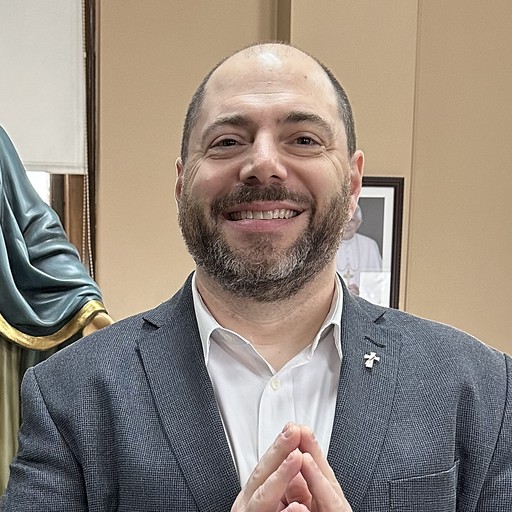
I’m a permanent deacon and I write it because I need it myself. You don’t have to preach to use it.
Notes
- Catechism of the Catholic Church, 2nd ed. (Vatican City: Libreria Editrice Vaticana, 1997), nos. 675-677. ↩
- John Chrysostom, Homily 4 on Second Thessalonians, in Nicene and Post-Nicene Fathers, First Series, vol. 13, ed. Philip Schaff (Buffalo, NY: Christian Literature Publishing, 1889), on 2 Thessalonians 2:15. ↩
- Second Vatican Council, Dei Verbum (Vatican City: Libreria Editrice Vaticana, 1965), nos. 9-10; Catechism of the Catholic Church, no. 83. ↩
- Jerome, in Thomas Aquinas, Catena Aurea: Commentary on the Four Gospels, Collected out of the Works of the Fathers, vol. 1, St. Matthew (Oxford: John Henry Parker, 1841), on Matthew 23:23. ↩
- Jerome and Gregory the Great (Moralia 1.15), in Aquinas, Catena Aurea, vol. 1, St. Matthew, on Matthew 23:24. ↩
- Jerome, in Aquinas, Catena Aurea, vol. 1, St. Matthew, on Matthew 23:25. ↩
- John Chrysostom, in Aquinas, Catena Aurea, vol. 1, St. Matthew, on Matthew 23:26; see also Origen at the same place, “we should hasten to become righteous, not to seem so.” ↩
- Catechism of the Catholic Church, nos. 1430-1431. ↩
- Thomas Aquinas, Summa Theologiae II-II, q. 30, a. 4. ↩
- Leo XIII, Rerum Novarum (Vatican City: Libreria Editrice Vaticana, 1891), no. 22, citing Thomas Aquinas, Summa Theologiae II-II, q. 66, a. 2. ↩
Books Cited
As an Amazon Associate I earn from qualifying purchases.
- Catholic Church, Catechism of the Catholic Church, 2nd ed. (Doubleday / Image, 2003)
- Philip Schaff, ed., Nicene and Post-Nicene Fathers, First Series, 14-volume set (Hendrickson)
- St. Thomas Aquinas, Catena Aurea: Commentary on the Four Gospels, 4-volume set (Baronius Press)
Leave a Reply