
Elijah has just won. Fire fell on Carmel, the 450 prophets of Baal are dead, the drought has broken, and the whole nation watched it happen. Then one woman sends one threat, and the prophet runs for his life into the desert and asks God to kill him. That is the man crouched in the cave at Horeb when the Lord tells him to come outside and stand on the mountain.
What happens next is the part we keep getting backward. A wind strong enough to break rocks. An earthquake. A fire. And God is in none of them. He is in the thin silence that follows, a sound so small that Elijah has to be listening for it.
We would rather have the wind. A God who overwhelms us from the outside would settle the question once and for all, and faith would cost us nothing. But Elijah had already seen fire fall from heaven, and it did not keep him from wanting to die a few days later. Peter walks on water in today’s Gospel and sinks the moment he notices how hard the wind is blowing. The spectacle proves something about God’s power. It does not by itself teach a man to trust.
August 9 is the day the Church remembers Saint Teresa Benedicta of the Cross, though this year the Nineteenth Sunday in Ordinary Time takes precedence at Mass. She died on this date in 1942, in a place where the wind and the earthquake and the fire were the only things anyone could see. Keep her in mind as you read.

The Readings
First Reading: 1 Kings 19:9a, 11-13a
And there he came to a cave, and lodged there.
And he said, “Go forth, and stand upon the mount before the Lord.” And behold, the Lord passed by, and a great and strong wind rent the mountains, and broke in pieces the rocks before the Lord, but the Lord was not in the wind; and after the wind an earthquake, but the Lord was not in the earthquake; and after the earthquake a fire, but the Lord was not in the fire; and after the fire a still small voice. And when Elijah heard it, he wrapped his face in his mantle and went out and stood at the entrance of the cave.
Gospel: Matthew 14:22-33
Then he made the disciples get into the boat and go before him to the other side, while he dismissed the crowds. And after he had dismissed the crowds, he went up into the hills by himself to pray. When evening came, he was there alone, but the boat by this time was many furlongs distant from the land, beaten by the waves; for the wind was against them. And in the fourth watch of the night he came to them, walking on the sea. But when the disciples saw him walking on the sea, they were terrified, saying, “It is a ghost!” And they cried out for fear. But immediately he spoke to them, saying, “Take heart, it is I; have no fear.”
And Peter answered him, “Lord, if it is you, bid me come to you on the water.” He said, “Come.” So Peter got out of the boat and walked on the water and came to Jesus; but when he saw the wind, he was afraid, and beginning to sink he cried out, “Lord, save me.” Jesus immediately reached out his hand and caught him, saying to him, “O man of little faith, why did you doubt?” And when they got into the boat, the wind ceased. And those in the boat worshiped him, saying, “Truly you are the Son of God.”
Scriptural Analysis
Begin with what the Lectionary leaves out, because the omitted verses set up everything the reading says. Jezebel’s messenger reaches Elijah the morning after Carmel (1 Kings 19:2). He runs to Beer-sheba at the southern edge of Judah, leaves his servant, and walks another day into the wilderness. Under a broom tree he prays to die: “It is enough; now, O Lord, take away my life; for I am no better than my fathers” (1 Kings 19:4). An angel wakes him twice and feeds him a cake baked on hot stones and a jar of water, and on the strength of that food he walks 40 days and 40 nights to Horeb (1 Kings 19:5-8).
The numbers are doing theological work. Forty days and forty nights is Moses on the same mountain (Exodus 34:28), and it is Israel’s 40 years in the desert compressed into one prophet’s journey. The Navarre commentary points out that Elijah is repeating the exodus in his own body, fleeing a hostile power toward the mountain of the covenant, and that Christian tradition has read the angel’s bread as a figure of the Eucharist. The Roman Catechism makes the connection explicitly: strengthened by this Sacrament, believers walk to their end as Elijah walked to Horeb on the strength of the bread baked on the hearth.[1] Hold on to that. The reading we hear today is the destination of a journey that only happened because God fed a man who wanted to die.
At Horeb, Elijah “came to a cave, and lodged there.” The Hebrew has the definite article, the cave, which the Fathers connected to the cleft of the rock where Moses was hidden while the glory of God passed by (Exodus 33:22). The Catechism draws the same line: Elijah, like Moses before him, hides in the cleft of the rock until the mysterious presence of God has passed by, and only on the mountain of the Transfiguration will the two of them see the face they were looking for.[2] That is worth sitting with. Moses and Elijah spend their lives seeking a face they are not permitted to see, and when they finally see it, it belongs to a Galilean carpenter standing on Tabor.
Then the theophany. Wind, earthquake, fire. Every one of these is standard equipment at Sinai: the mountain trembled and smoked, and the Lord descended in fire (Exodus 19:16-18). Elijah has every reason to expect God in them. The text says three times that he was not. What comes instead is qol demamah daqqah, a phrase almost impossible to render, something like the sound of a thin silence. Saint Irenaeus read the sequence as prophecy. In the light of the Law given to Moses, he says, the coming of the Lord in human form will be an untroubled time when the bent reed is not crushed, and the flickering flame is not quenched, and after the wind that moves mountains, after earthquake and fire, the calm and peaceful age of his reign will come.[3] The whisper on Horeb is the Incarnation being rehearsed.
Saint Ephrem the Syrian adds the pastoral point. The Lord instructs the prophet through these figures in order to correct his excessive zeal and to lead him to imitate the providence of the Most High, who governs the judgments of his justice through the abundance of his mercy.[4] Elijah has spent three chapters calling down fire on Israel’s apostasy, and he was right to. God’s answer is that his own preferred instrument is a whisper. And notice Elijah’s reaction: he wraps his face in his mantle. Ephrem hears him saying that the creature is not worthy of seeing his Creator.[5] The one thing that made him cover his eyes was the quiet.
Now the Gospel, which begins at a moment the Lectionary hides again. “Then he made the disciples get into the boat.” Then, meaning right after the multiplication of the loaves. Matthew tells that miracle in deliberately eucharistic language: Jesus took, blessed, broke, and gave, the same four verbs in the same order he will use at the Last Supper (Matthew 14:19; 26:26), and both scenes happen in the evening with the guests reclining.[6] So the pattern of the First Reading repeats. Bread first, then the mountain, then the encounter.
Jesus dismisses the crowd and goes up the mountain alone to pray. Saint Thomas Aquinas takes this as a lesson in method: prayer requires quiet of mind, elevation, and solitude, and the dismissal of the crowd stands for the dismissal of the disturbing thoughts that make prayer impossible, which is why the Lord tells us to shut the door of our room and of our heart (Matthew 6:6).[7] Christ does not need to pray. He prays so we will know how.
Meanwhile, the boat is being battered “many furlongs” out, with the wind against it. Jesus comes in the fourth watch, the Roman division of the night between three and six in the morning, which means the disciples have fought the water for the better part of eight hours. Saint John Chrysostom asks why the Lord waited. He answers that Christ did not present himself at once, teaching them not to seek deliverance hastily from their pressing dangers, but to bear all occurrences manfully.[8] The delay is the lesson.
And when he does come, they are more frightened, not less. A figure walking on the sea reads as a ghost. Then he speaks: “Take heart, it is I; have no fear.” The Greek behind “it is I” is ego eimi, I AM, the name given at the burning bush (Exodus 3:14) and used repeatedly by the God of Isaiah, where it stands beside the command “fear not” (Isaiah 41:4; 43:10).[9] Put that next to what he is doing while he says it. Scripture reserves walking on the waves to God alone (Job 9:8; Habakkuk 3:15), along with stilling storms (Psalm 107:28-30) and reaching down to pull the drowning out of deep water (Psalm 18:16; 144:7). Jesus is speaking God’s name while performing God’s work, in front of Jewish fishermen who would catch every reference.
Peter’s request is the most Peter thing in the Gospels. Aquinas notices the exact wording: he did not say “pray for me,” he said “bid me come to you,” which is an act of enormous confidence in Christ’s power.[10] Chrysostom notices something else. Peter does not ask to walk on the water. He asks to come to Jesus, because nobody loved him like that.[11] What Peter wants is Jesus. The water is only what happens to be in between.
Then he sees the wind and starts to go under. Aquinas is blunt about why the Lord allowed it: Peter walked by the power of Christ and sank by his own weakness, and God permitted the sinking because this man was going to be a shepherd, so he needed to know both.[12] The rescue is where the theology lands. Jesus stretches out his hand, and Aquinas hears the Psalm underneath it: “Put forth your hand from on high, take me out, and deliver me from many waters” (Psalm 144:7).[13] The rebuke that follows, “O man of little faith, why did you doubt,” is a correction aimed at building the man up. Jesus wants a stronger faith out of him next time.[14]
One more layer, and it is the reason this passage has been preached on for 20 centuries. Aquinas reads the boat as the Church and the sea as the world, tossed by waves because someone is always making war on her, and unable to sink because Christ is praying.[15] Look at the sequence with that in mind. The wind does not stop when Jesus walks on it, and it does not stop when Peter gets out. It stops when Christ gets into the boat. That is the same lesson Elijah learned on the mountain. God is not in the wind, and he does not have to compete with it. He arrives quietly, and the storm is simply over. And the men in the boat say what no one in Matthew has said yet: “Truly you are the Son of God,” the first of three such confessions in this Gospel (Matthew 16:16; 27:54).
Daily Application
There is a lie that runs quietly under a great deal of Catholic discouragement, and it goes like this: if God were really here, I would be able to tell. The noise in my life is loud, the answers are slow, the same sin keeps winning, and if he were present it would feel like something. Elijah believed a version of it on Horeb. So did Peter, one second after stepping out of the boat.
Both readings answer it the same way. God’s ordinary manner of coming is quiet, and quiet is not absence. So the interior movement today’s Scripture asks for is a decision, made in the dark, to keep trusting a presence you cannot currently detect. That is precisely what the virtue of faith is for. Saint Thomas locates faith’s object in things unseen, and if we only believed what the storm let us feel, we would not be believing at all.
Two things follow, and they are practical.
First, feed yourself before the journey. Elijah made it 40 days on bread God gave him in the desert, and he needed it precisely because he was too exhausted to want to live. That is a fair description of a lot of Catholics right now. Sunday Mass is the food for the walk to the mountain, and it is given to people who are worn out. If you are running on empty, the answer is more Eucharist. Go to confession first if you need to, then receive, then let the food do its work over 40 days rather than over 40 minutes.
Second, build a place where a whisper could be heard. If wind, earthquake, and fire are all that ever reach your ears, the still small voice will pass through your day unnoticed. Ten minutes of silence in front of the Blessed Sacrament will do more than an hour of religious content. Turn the car radio off on the drive home. Read three verses slowly instead of a chapter quickly. The Lord is not hiding. He is speaking at a volume that requires you to stop talking.
And when you are sinking, pray Peter’s prayer. Three words: “Lord, save me.” Do not wait until you have composed something worthy. Peter was flailing in the water, and half a sentence was enough, and the hand came out immediately.
Saint Teresa Benedicta of the Cross lived this to the end of it. She was a philosopher trained to attend carefully to what actually shows itself, and when she read Teresa of Avila’s autobiography in a single night, she followed the truth into the Church, into Carmel, and finally into a cattle car. Auschwitz on August 9, 1942, offered every visible sign that God had left the building. She had spent 20 years learning to hear him underneath that kind of noise, and she walked in with her sister Rosa still hearing him. Her translator summed up her whole life in one phrase: learn to live at God’s hands.[16]
Learn to live at God’s hands. Get in the boat, take the bread he gives you, and go find somewhere quiet enough to hear him.
Preparing for Sunday
This reflection is part of the daily readings. Every week I also write a full prep guide for the coming Sunday: all four readings in full, the Fathers, Aquinas and the Catechism cited properly, and three developed themes worked out at length.
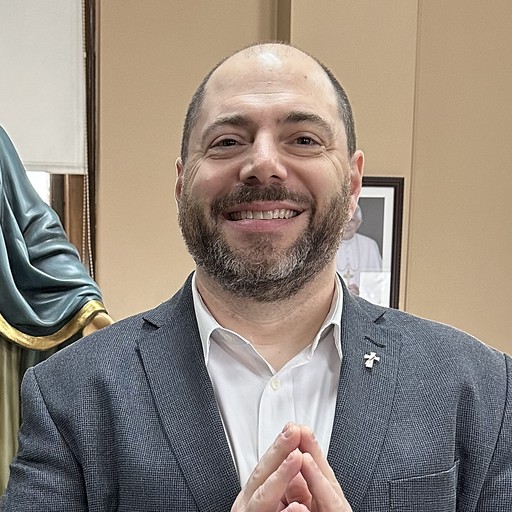
I’m a permanent deacon and I write it because I need it myself. You don’t have to preach to use it.
Notes
- The Navarre Bible: Joshua–Kings, Revised Standard Version, Catholic Edition (Dublin: Four Courts Press), commentary on 1 Kings 19:1–8, citing the Roman Catechism, 2, 4, 54. ↩
- Catechism of the Catholic Church, 2nd ed. (Washington, DC: United States Conference of Catholic Bishops, 2000), no. 2583. ↩
- Irenaeus of Lyons, Against Heresies 4.20.10, quoted in The Navarre Bible: Joshua–Kings, commentary on 1 Kings 19:9–14. ↩
- Ephrem the Syrian, On the First Book of Kings 19.11, in Marco Conti, ed., 1–2 Kings, 1–2 Chronicles, Ezra, Nehemiah, Esther, Ancient Christian Commentary on Scripture, Old Testament 5 (Downers Grove, IL: InterVarsity Press, 2008), 118. ↩
- Ephrem the Syrian, On the First Book of Kings 19.13, in Conti, 1–2 Kings, 118. ↩
- Curtis Mitch and Edward Sri, The Gospel of Matthew, Catholic Commentary on Sacred Scripture (Grand Rapids, MI: Baker Academic, 2010), 190. ↩
- Thomas Aquinas, Commentary on the Gospel of Saint Matthew, chap. 14, lect. 2, no. 1258. ↩
- John Chrysostom, Homilies on the Gospel of Saint Matthew, Homily 50, in Nicene and Post-Nicene Fathers, First Series, vol. 10 (Buffalo, NY: Christian Literature Company, 1888), 310. ↩
- Daniel J. Harrington, The Gospel of Matthew, Sacra Pagina 1 (Collegeville, MN: Liturgical Press, 1991), 224. ↩
- Aquinas, Commentary on Matthew, chap. 14, lect. 2, no. 1270. ↩
- Chrysostom, Homily 50, in NPNF, First Series, 10:311. ↩
- Aquinas, Commentary on Matthew, chap. 14, lect. 2, no. 1273. ↩
- Aquinas, Commentary on Matthew, chap. 14, lect. 2, no. 1275. ↩
- Mitch and Sri, The Gospel of Matthew, 192. ↩
- Aquinas, Commentary on Matthew, chap. 14, lect. 2, no. 1260. ↩
- Josephine Koeppel, O.C.D., quoted in “Saint Teresa Benedicta of the Cross,” Saint of the Day, Franciscan Media, accessed August 8, 2026, https://www.franciscanmedia.org/saint-of-the-day/saint-teresa-benedicta-of-the-cross/. ↩
Books Cited
As an Amazon Associate I earn from qualifying purchases.
- Catholic Church, Catechism of the Catholic Church, Second Edition, Doubleday / Image, 2003
- Curtis Mitch and Edward Sri, The Gospel of Matthew, Catholic Commentary on Sacred Scripture (Baker Academic, 2010)
- Daniel J. Harrington, SJ, The Gospel of Matthew, Sacra Pagina 1 (Liturgical Press)
- Philip Schaff, ed., Nicene and Post-Nicene Fathers, First Series, 14-volume set (Hendrickson)
- University of Navarre, The Navarre Bible: Joshua to Kings, Scepter Publishers
- St. Thomas Aquinas, Commentary on the Gospel of Matthew 13-28, Latin-English Opera Omnia (Emmaus Academic)
Leave a Reply