
The most accurate thing anyone says about Jesus in the Capernaum synagogue comes out of the mouth of a demon. “I know who you are, the Holy One of God.” The congregation is astonished, and astonishment is not a confession. Peter will not say anything this exact until chapter nine. The unclean spirit has the Christology perfectly right, and it does him no good whatsoever.
Most of us quietly assume our problem is information. If we understood more, we would love more. If the teaching were clearer, the obedience would follow. Paul takes that assumption apart in this morning’s first reading. The Spirit searches even the depths of God, and what he hands over is the mind of Christ, which is a gift and not an achievement. Today’s saint left behind no writings and barely a verifiable biography. Europe trusted him for eight hundred years anyway.

The Readings
First Reading: 1 Corinthians 2:10b-16
God has revealed to us through the Spirit. For the Spirit searches everything, even the depths of God. For what person knows a man’s thoughts except the spirit of the man which is in him? So also no one comprehends the thoughts of God except the Spirit of God. Now we have received not the spirit of the world, but the Spirit which is from God, that we might understand the gifts bestowed on us by God. And we impart this in words not taught by human wisdom but taught by the Spirit, interpreting spiritual truths to those who possess the Spirit.
The unspiritual man does not receive the gifts of the Spirit of God, for they are folly to him, and he is not able to understand them because they are spiritually discerned. The spiritual man judges all things, but is himself to be judged by no one. “For who has known the mind of the Lord so as to instruct him?” But we have the mind of Christ.
Gospel: Luke 4:31-37
And he went down to Capernaum, a city of Galilee. And he was teaching them on the sabbath; and they were astonished at his teaching, for his word was with authority. And in the synagogue there was a man who had the spirit of an unclean demon; and he cried out with a loud voice, “Ah! What have you to do with us, Jesus of Nazareth? Have you come to destroy us? I know who you are, the Holy One of God.” But Jesus rebuked him, saying, “Be silent, and come out of him!” And when the demon had thrown him down in the midst, he came out of him, having done him no harm. And they were all amazed and said to one another, “What is this word? For with authority and power he commands the unclean spirits, and they come out.” And reports of him went out into every place in the surrounding region.
Scriptural Analysis
The Spirit Who Searches The Depths
Paul is writing to a church that has fractured itself over teachers. Some belong to Paul, some to Apollos, some to Cephas (1 Corinthians 1:12). Underneath the party spirit sits a mistake about wisdom, and chapters one through four are his long correction of that mistake. Our passage is the second half of that correction, the part where he stops saying what wisdom is not and starts describing how anyone comes to possess it.
The verb in verse 10 is worth slowing down for. The Spirit searches everything. The Greek is eraunaō, which means to explore, to examine, to search out. Paul uses it in only one other place, and there it describes God searching human hearts (Romans 8:27). Now he turns the same verb around and points it at God himself. The word for “depths” carries its own weight: in the Greek Old Testament it names the depths of the sea and the depths of the earth (Psalm 69:3, Ezekiel 26:20), and it gets transferred to the sheer inaccessibility of God, as when Paul cries out over “the depth of the riches and wisdom and knowledge of God” (Romans 11:33).[1]
Verse 11 gives the reason, and Paul argues it almost like a syllogism. No one knows a man’s thoughts except that man’s own spirit. So no one knows God except God’s own Spirit. The Spirit can disclose the heart of God because he is the heart of God. George Montague puts the practical upshot memorably: without the Holy Spirit, the gifts of God would mean nothing more to us “than a pot of gold to an elephant.”[2] The gold is real. The elephant is simply not equipped.
That is exactly the diagnosis Paul makes in verse 14. The RSVCE calls him the “unspiritual man.” The Greek is psychikos anthrōpos, the person moved only by the soul, the psychē, with its powers of reasoning and choosing, and closed off to the spirit, the pneuma, which is where a human being reaches past himself toward God. Paul prays elsewhere for the whole person, “spirit and soul and body” (1 Thessalonians 5:23), and Saint Thomas Aquinas draws the same line inside the soul itself, distinguishing its reasoning function from its contemplative one.[3] There is real reason to think Paul is borrowing the Corinthians’ own vocabulary here and turning it back on them with some irony. The people in Corinth calling themselves spiritual were the ones dividing the church.
Consider verse 15, and an image from Aquinas that lands directly on today’s Gospel. The spiritual man judges all things and is himself judged by no one. This does not mean he stands above correction or above the Church; Paul is scolding the Corinthians precisely for refusing legitimate authority. Aquinas explains it by comparing a sleeping man and a waking one. The awake one can judge the sleeper accurately. The sleeper cannot return the favor.[4]
Paul finishes by quoting Isaiah: “For who has known the mind of the Lord so as to instruct him?” (Isaiah 40:13). The expected answer is nobody. And then the reversal. But we have the mind of Christ. Notice the shift. Paul has been talking about spirit for six verses and now moves to mind, the faculty that selects, compares, weighs, and orders. The Holy Spirit does not shut down the intellect and replace it with feeling. He takes hold of the intellect and turns it, which is why Paul can tell the Romans to “be transformed by the renewal of your mind” (Romans 12:2).[5]
Authority In Capernaum
Yesterday Nazareth tried to throw Jesus off a cliff. Today he walks about twenty-five miles northeast to Capernaum, a fishing town of maybe a thousand people on the northwestern shore of the Sea of Galilee. Luke writes that he “went down,” and he means it literally: Capernaum sits roughly six hundred meters lower than Nazareth. Mark had written, “they entered.” Luke changes it to the singular because he has moved the call of Peter down to chapter five, so Jesus arrives alone.[6]
Luke says the people were astonished “for his word was with authority.” The Greek word used here is exousia. Mark adds a comparison at this point: Jesus taught “and not as the scribes.” Luke drops it. His readers are not fighting the rabbis, and he wants the source of the authority located somewhere other than learning: the Spirit who descended at the Jordan (Luke 3:22) and the anointing Jesus claimed in the Nazareth synagogue yesterday (Luke 4:18).[7]
Then the cry from the back of the synagogue. Luke describes the man with a clumsy double phrase, “the spirit of an unclean demon,” expanding what Mark wrote. He clarifies something for Gentile readers who would not automatically hear daimonion as evil; in the wider Greek world, a daimōn could be a perfectly respectable spirit.[8] The interjection translated “Ah!” is ea, an old past participle that carries displeasure or alarm, and the phrase that follows, “What have you to do with us,” is a Hebrew idiom that in this setting means open hostility.[9]
Then the confession: the Holy One of God. The title appears in the Synoptics only here and in Mark’s parallel. It may echo Psalm 106:16, where Aaron is called “the holy one of the LORD,” which would be pointed, since Aaron’s job was to separate the clean from the unclean (Leviticus 10:10), and Jesus is about to expel something unclean. It may also pick up Elisha, “a holy man of God” (2 Kings 4:9), whom Jesus had just invoked in the Nazareth sermon. Either way, the demon has correctly identified the man in front of him as belonging to God.[10]
Watch what Jesus does with it. He rebukes him. The verb is epitimaō, and here it is technical rather than emotional. In the Greek Old Testament it renders the Hebrew ga’ar, the shout that drives back evil: the Lord rebukes Satan in Zechariah 3:2 and rebukes the Red Sea in Psalm 106:9. It belongs to the vocabulary of the final defeat of the powers, and it is strikingly absent from the pagan exorcism accounts and the Greek magical papyri. The command itself, “Be silent,” is literally “be muzzled” (see Deuteronomy 25:4).[11]
Two details in verse 35 are Luke’s own. The demon throws the man down in the midst, in front of everyone, so that nobody can claim it did not happen. And the man is released “having done him no harm.” Luke will not let the deliverance cost the man anything.[12]
The crowd asks the right question: “What is this word?” Mark had them marveling at a new teaching. Luke keeps it on the logos, the word, which he has been tracking since his prologue. And he pairs exousia with dynamis, authority with power. The devil had offered Jesus exousia over the kingdoms of the world back in the desert (Luke 4:6). Jesus now spends it dismantling the devil’s own household.[13] Four verses later, he will use that same verb, rebuke, on a fever in Peter’s house, which is Luke’s way of tying the two miracles together. The release he announced in Nazareth, “liberty to the captives,” has started.[14]
Put the two readings side by side, and the point sharpens. The demon possesses accurate information about Jesus and is not saved by one syllable of it. What he lacks is surrender. Paul’s unspiritual man cannot receive the things of the Spirit, and the demon will not, and in the end both walk away with nothing. The people in the synagogue understand almost none of it and are on far better ground, because they are asking.
Daily Application
There is a particular temptation for people who love the faith enough to study it. I feel it constantly. The temptation is to believe the gap between where I am and where I should be is a gap in understanding, and that the next book, the next class, the next well-argued article will close it. Sometimes that is true. Paul is not anti-intellectual, and neither is the Church that produced Aquinas. The Holy Spirit engages the mind and transforms it.
But knowing the theology of the Eucharist and being fed by the Eucharist are two different events, and only one of them happens by reading. You can explain the problem of suffering with real precision and still refuse to forgive the person who caused yours. You can defend the Church’s teaching all afternoon online and go eleven months without confession. The demon in Capernaum is the extreme case of a real spiritual danger: theological accuracy running on its own, disconnected from any willingness to submit.
So the movement today’s readings ask for is surrender, where knowledge has been standing in for obedience and repentance. Try this. Before you open the Scriptures this week, take ten seconds and ask the Holy Spirit to search you, because Paul says that is what he does, and you cannot do it for yourself. Then name one thing you already know is true and have not acted on. Not ten things. One. The gap between what we know and what we do is where the spiritual life actually happens, and it closes by obedience, prayer, and the sacraments.
Today the Church remembers Saint Giles, and he fits this exactly. We know almost nothing about him with certainty. Probably born in southeastern France in the first half of the seventh century. He built a monastery that became a stop for pilgrims heading to Compostela and to the Holy Land. That is close to the whole biography. No treatises, no famous school, no martyrdom. And yet ancient churches and hospitals across England were dedicated to him, a section of Brussels carries his name, and Germany counted him among the Fourteen Holy Helpers, the saints people begged for healing and for strength in the hour of death. He was the only one in that group who was not a martyr. The word martyr means witness, yet Giles was a true witness without being martyred. He became the patron of beggars, the poor, and the disabled, which tells you what people believed he would do if they asked.
Giles did not have Paul’s education or Aquinas’s mind. He had the mind of Christ, which is given, and he lived like a man who had received it.
You have been given the same Spirit who searches the depths of God. Ask him to search you today, and then do the one thing you already know you need to do to grow spiritually.
Preparing for Sunday
This reflection is part of the daily readings. Every week I also write a full prep guide for the coming Sunday: all four readings in full, the Fathers, Aquinas and the Catechism cited properly, and three developed themes worked out at length.
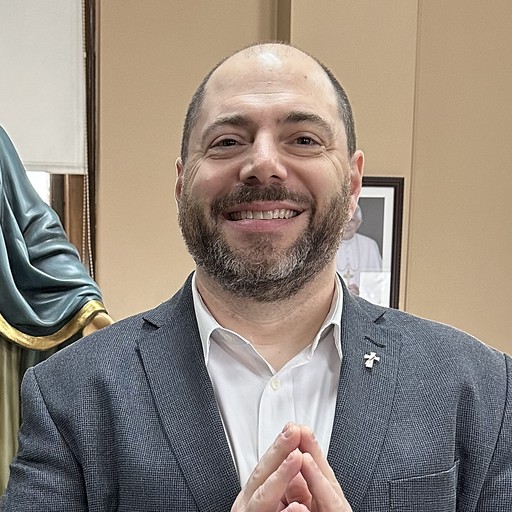
I’m a permanent deacon and I write it because I need it myself. You don’t have to preach to use it.
Notes
- George T. Montague, First Corinthians, Catholic Commentary on Sacred Scripture (Grand Rapids, MI: Baker Academic, 2011), 65. ↩
- Montague, First Corinthians, 66. ↩
- Montague, First Corinthians, 67, citing Thomas Aquinas, Summa Theologiae Ia.79.9; Raymond F. Collins, First Corinthians, Sacra Pagina 7 (Collegeville, MN: Liturgical Press, 1999), 136. ↩
- Montague, First Corinthians, 68. ↩
- Montague, First Corinthians, 69; Collins, First Corinthians, 137-38. ↩
- Joseph A. Fitzmyer, The Gospel According to Luke I-IX, Anchor Bible 28 (Garden City, NY: Doubleday, 1981), 543-44; Pablo T. Gadenz, The Gospel of Luke, Catholic Commentary on Sacred Scripture (Grand Rapids, MI: Baker Academic, 2018), 104-5. ↩
- Fitzmyer, Luke I-IX, 544. ↩
- Gadenz, The Gospel of Luke, 105; Luke Timothy Johnson, The Gospel of Luke, Sacra Pagina 3 (Collegeville, MN: Liturgical Press, 1991), 83. ↩
- Fitzmyer, Luke I-IX, 545. ↩
- Gadenz, The Gospel of Luke, 105; Fitzmyer, Luke I-IX, 546. ↩
- Fitzmyer, Luke I-IX, 546. ↩
- Fitzmyer, Luke I-IX, 546; Johnson, The Gospel of Luke, 84. ↩
- Johnson, The Gospel of Luke, 84. ↩
- Gadenz, The Gospel of Luke, 106-7. ↩
Books Cited
As an Amazon Associate I earn from qualifying purchases.
- George T. Montague, First Corinthians, Catholic Commentary on Sacred Scripture (Baker Academic, 2011)
- Raymond F. Collins, First Corinthians, Sacra Pagina 7 (Liturgical Press)
- Joseph A. Fitzmyer, The Gospel According to Luke I-IX, Anchor Bible 28 (Doubleday, 1981)
- Pablo T. Gadenz, The Gospel of Luke, Catholic Commentary on Sacred Scripture (Baker Academic, 2018)
- Luke Timothy Johnson, The Gospel of Luke, Sacra Pagina 3 (Liturgical Press)
Leave a Reply