
We want to be the reason something worked. That instinct is quieter than pride yet harder to name, and it hides best inside good work: the class you taught, the child you raised in the faith, the parish you helped hold together. Paul takes a scalpel to it in nine verses. He planted, Apollos watered, and neither one of them is anything. God gave the growth. The Corinthians thought they had graduated into spiritual maturity, but Paul writes back to call them babies, because the surest sign that a soul is still an infant is that it keeps score. Today the Church remembers 191 priests who were cut down in a Paris convent before any of them saw the harvest of their labor. They prove what Paul is saying. The growth was never theirs to see.

The Readings
First Reading: 1 Corinthians 3:1-9
But I, brethren, could not address you as spiritual men, but as men of the flesh, as babes in Christ. I fed you with milk, not solid food; for you were not ready for it; and even yet you are not ready, for you are still of the flesh. For while there is jealousy and strife among you, are you not of the flesh, and behaving like ordinary men? For when one says, “I belong to Paul,” and another, “I belong to Apollos,” are you not merely men?
What then is Apollos? What is Paul? Servants through whom you believed, as the Lord assigned to each. I planted, Apollos watered, but God gave the growth. So neither he who plants nor he who waters is anything, but only God who gives the growth. He who plants and he who waters are equal, and each shall receive his wages according to his labor. For we are God’s fellow workers; you are God’s field, God’s building.
Gospel: Luke 4:38-44
And he arose and left the synagogue, and entered Simon’s house. Now Simon’s mother-in-law was ill with a high fever, and they besought him for her. And he stood over her and rebuked the fever, and it left her; and immediately she rose and served them.
Now when the sun was setting, all those who had any that were sick with various diseases brought them to him; and he laid his hands on every one of them and healed them. And demons also came out of many, crying, “You are the Son of God!” But he rebuked them, and would not allow them to speak, because they knew that he was the Christ.
And when it was day he departed and went into a lonely place. And the people sought him and came to him, and would have kept him from leaving them; but he said to them, “I must preach the good news of the kingdom of God to the other cities also; for I was sent for this purpose.” And he was preaching in the synagogues of Judea.
Scriptural Analysis
Infants Who Think They Are Adults
Paul has spent two chapters on the cross and on the wisdom that only the Spirit can give. Now he turns and applies it all to the mess in front of him. The Corinthians had reported themselves as pneumatikoi, spiritual people, and some of them used the word teleioi, the mature, the perfect (1 Corinthians 2:6). Paul takes their own vocabulary and hands it back reversed. He could not speak to them as spiritual people. He spoke to them as nepioi, infants in Christ.[1]
The irony is sharper in Greek than in English. In the Hellenistic world, “infant” was a common insult for someone silly or foolish, so the word lands as both tenderness and rebuke at once. Paul is their father in the faith, and he uses a mother’s image to say it: he gave them milk to drink, because they could not chew. He uses that maternal picture elsewhere, comparing himself to a nurse with her children (1 Thessalonians 2:7) and to a woman in labor (Galatians 4:19). Milk is exactly right for the newly baptized. But this letter comes three to five years after Paul first preached in Corinth, and the author of Hebrews says plainly what should have happened by then: by this time you ought to be teachers, and you still need someone to teach you the first principles (Hebrews 5:12-13).[2]
So what evidence shows they are still infants? Paul points to jealousy and strife, a failure of charity rather than of catechesis. “Flesh,” for Paul, is the human person considered as weak, exposed to forces hostile to God, and prone to sin. To be of the flesh is to hand yourself over to jealousy and rivalry, and so to tear down the body of Christ instead of building it up.[3] Corinth was a city organized around patrons. A man secured himself by attaching himself to somebody powerful, and repaid the favor with loyalty and public praise, and both parties gained. The Corinthians dragged that arrangement straight into the Church. “I belong to Paul.” “I belong to Apollos.” They were shopping for a spiritual patron who would guarantee their dignity, and the effect, whether they intended it or not, was to advertise their man as better than everyone else’s.[4]
Notice how Paul dismantles it. He asks, “What then is Apollos? What is Paul?” The Greek is ti, the neuter, the way you ask about a tool rather than a man. And he answers with diakonoi: servants, waiters, table-hands. Servants through whom you believed, and even the believing was assigned by the Lord.[5]
Planters, Waterers, And The One Who Gives Life
Then comes the line the whole chapter turns on. “I planted, Apollos watered, but God gave the growth.” The verb is auxano, the ordinary word for a field coming up, and Paul puts a hard adversative in front of God: alla, but God. Two men worked. One of them started a church. Neither of them can make a single seed swell in the ground.[6]
Which is why the very next sentence flattens the ranking the Corinthians were building: neither the one who plants nor the one who waters is anything. Then Paul says something easy to skip. He who plants and he who waters “are one and the same,” and each will receive wages according to his own labor. Their equality comes from belonging to the same Master, which is a different thing entirely from equal talent or equal results. And the assessment of what each man’s work was worth belongs to that Master, not to the Corinthians running their popularity contest.[7]
Verse 9 seals it with a word repeated three times, each time in the possessive: God’s fellow workers, God’s field, God’s building. The grammar makes Paul and Apollos coworkers with one another, in God’s service and on God’s payroll, and it keeps the whole enterprise, workers and field alike, in God’s possession. Any reading that turns them into junior partners supplying the effort while God supplies the power runs against the possessives.[8] Saint John Chrysostom saw the pastoral point immediately: “If you are God’s field, it is right that you should be so called not because of those who cultivate you, but because of God, for the field is not the worker’s but the owner’s.” And then he presses it home against the divisions: if you are a farm, you must not be divided, but walled in by a single fence, which is unanimity.[9] The Catechism keeps both of Paul’s images, the field and the building, when it describes what the Church is (CCC 755-756).[10]
Capernaum: Healed, Risen, Serving
Luke moves from the synagogue to a kitchen. Jesus “arose and left” the synagogue where he had just cast out an unclean spirit, and walked into Simon’s house. Archaeologists have uncovered a cluster of black basalt homes about thirty yards from the Capernaum synagogue, one of which may well be Peter’s.[11] Simon has not been called yet. Luke deliberately moves the call of the first disciples to the end of this sequence (Luke 5:1-11), so his readers meet Simon first as a man with a sick mother-in-law and a house that Jesus enters. The favor done here quietly prepares the ground for the day Simon leaves everything.[12]
Luke describes the fever more severely than Mark does. His phrase is closer to “seized by a great fever,” and he uses it so that his readers understand what kind of power it takes to break it.[13] And then Luke does something the other evangelists do not: he says Jesus rebuked the fever. It is the same verb he used for the demon a few verses earlier, and will use again at sunset for the demons who know who Jesus is. Those three scenes are bound together by that one word, and the point is that Jesus heals by command, by the authority of his word, with no incantation, no technique, nothing but speech that does what it says.[14]
The Fathers read the pairing carefully. Saint Ambrose noticed that Luke heals a man first and then a woman, and saw in the woman’s fever a figure of our flesh burning under the fevers of sin, adding that the fever of lust is no cooler than the fever of the body. Saint Bede followed the same line: the man freed from the devil is the mind cleansed of unclean thoughts, and the woman cured of fever is the flesh brought back under discipline. And Saint Cyril of Alexandria stopped at something simpler and just as sharp: that Christ chose to stay in the house of a poor man, so that we would stop looking past the poor.[15]
Two Greek words in verse 39 open the whole scene. The fever “left” her, aphiemi, the verb behind aphesis, the “release” Jesus had announced in the synagogue at Nazareth when he read Isaiah and said the Spirit had sent him to proclaim liberty to captives (Luke 4:18). The jubilee he preached is now being handed out one body at a time. And “she rose” is anistemi, the same verb Luke uses for Jesus rising from the tomb (Luke 24:7). She gets up like a woman raised from the dead, and she waits on the table with her new life. The word is diakoneo, and it is the same word Jesus uses of himself: I am among you as one who serves (Luke 22:27).[16]
At sunset, the sabbath ends; people may carry burdens and walk distances again, and the whole town arrives at the door. Jesus lays his hands on each one individually, a gesture the Church still uses in the anointing of the sick (CCC 1519).[17] Then at daybreak he leaves. The crowds find him in the deserted place and try to hold him there, and this is the moment I keep coming back to. Capernaum wanted him. The growth was visible. And he says, “I must preach the good news of the kingdom of God to the other cities also; for I was sent for this purpose.” That “must” is dei, the word Luke uses for the Father’s plan, and “I was sent” is a passive with God as the unspoken sender.[18] This is the first time the kingdom of God is named in Luke’s Gospel, and it arrives attached to a departure.
Daily Application
Put the two readings side by side, and you get one hard sentence: the worker leaves, and the field belongs to God.
Jesus will not stay in the town that adores him. Paul will not let Corinth build a fan club around him. And the woman just raised off her sickbed gets up and feeds people while the wonder of it is still in the room. In every case, the credit slides off the human being and lands where it belongs, and the human being is freed to go do the next thing.
That is harder than it sounds, because most of us want to see the harvest. You teach the parish’s confirmation class for six years and cannot name one young person who still goes to Mass. You pray for a brother for two decades. You raise your children in the faith, and one of them stops going, and you turn it over at three in the morning looking for the mistake. Paul’s answer is not comfortable, but it is true: each will receive his wages according to his labor, and God judges the work. You are paid for the planting and the watering. You were never assigned the growth.
Today’s saints show what that costs when it is real. John Francis Burté entered the Franciscans at 16 and taught theology to young friars before he was made guardian of the friary in Paris. Appolinaris of Posat was a Capuchin preacher assigned to the missions in the East and was in Paris studying Oriental languages when the Revolution broke out. Severin Girault was a chaplain to a house of sisters. In 1791, the Civil Constitution of the Clergy required an oath that amounted to a denial of the faith; each of them refused it, and on September 2, 1792, they and 182 others were killed at the Carmelite house in Paris. Not one of them finished what he had started. Appolinaris never reached the missions he had learned the languages for. They were planters and waterers, and the growth came later, in a Church that still has their names.
The interior movement today’s readings ask for is a kind of surrender that looks like nothing from the outside. It is the decision to keep working a field you may never see green. It is refusing to attach your identity to a party inside the Church, whether that party gathers around a priest, a movement, a liturgical style, or a set of opinions you are certain are correct. That attachment feels like zeal from the inside. Paul, who knew the difference, calls it milk.
Then there is the smallest, most practical thing in the whole Gospel. The fever leaves her and immediately she rises and serves them. No interval. Whatever God has given you, and he has given you something, spend it on somebody today. Make the call you have been putting off. Sit with the person nobody sits with. Go to the sacrament of Confession, and let him rebuke the fever.
You are God’s field. Let him grow you, and get to work.
Preparing for Sunday
This reflection is part of the daily readings. Every week I also write a full prep guide for the coming Sunday: all four readings in full, the Fathers, Aquinas and the Catechism cited properly, and three developed themes worked out at length.
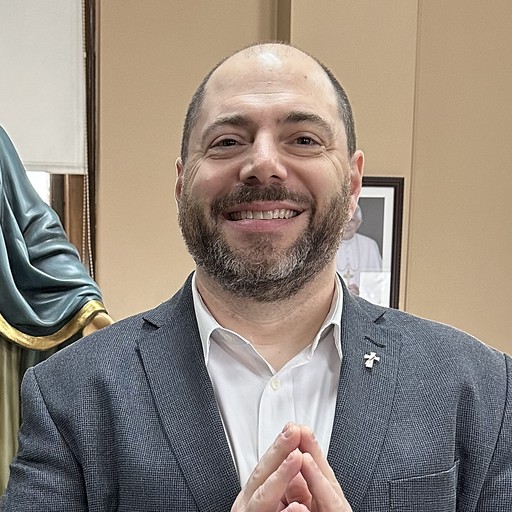
I’m a permanent deacon and I write it because I need it myself. You don’t have to preach to use it.
Notes
- Raymond F. Collins, First Corinthians, Sacra Pagina 7 (Collegeville, MN: Liturgical Press, 1999), 139-141. ↩
- Collins, First Corinthians, 141, 143; George T. Montague, First Corinthians, Catholic Commentary on Sacred Scripture (Grand Rapids, MI: Baker Academic, 2011), 72. ↩
- Montague, First Corinthians, 72; Collins, First Corinthians, 140, 143-144. ↩
- Montague, First Corinthians, 73. ↩
- Montague, First Corinthians, 72-73; Collins, First Corinthians, 145. ↩
- Collins, First Corinthians, 146. ↩
- Montague, First Corinthians, 73; Collins, First Corinthians, 146. ↩
- Collins, First Corinthians, 147. ↩
- John Chrysostom, Homilies on 1 Corinthians 8.6, quoted in Montague, First Corinthians, 74. ↩
- Catechism of the Catholic Church, 2nd ed. (Vatican City: Libreria Editrice Vaticana, 1997), nos. 755-756. ↩
- Pablo T. Gadenz, The Gospel of Luke, Catholic Commentary on Sacred Scripture (Grand Rapids, MI: Baker Academic, 2018), 106. ↩
- Joseph A. Fitzmyer, The Gospel According to Luke I-IX, Anchor Bible 28 (Garden City, NY: Doubleday, 1981), 549; Luke Timothy Johnson, The Gospel of Luke, Sacra Pagina 3 (Collegeville, MN: Liturgical Press, 1991), 85-86. ↩
- Fitzmyer, Gospel According to Luke I-IX, 550. ↩
- Fitzmyer, Gospel According to Luke I-IX, 550-551; Gadenz, Gospel of Luke, 106. ↩
- Ambrose, Bede, and Cyril of Alexandria, on Luke 4:38-39, in Thomas Aquinas, Catena Aurea: Commentary on the Four Gospels, Collected out of the Works of the Fathers, vol. 3, St. Luke, at Luke 4:38-39. ↩
- Gadenz, Gospel of Luke, 107; Fitzmyer, Gospel According to Luke I-IX, 549. ↩
- Gadenz, Gospel of Luke, 107; Catechism of the Catholic Church, no. 1519. ↩
- Fitzmyer, Gospel According to Luke I-IX, 557. ↩
Books Cited
As an Amazon Associate I earn from qualifying purchases.
- Raymond F. Collins, First Corinthians, Sacra Pagina 7 (Liturgical Press)
- George T. Montague, SM, First Corinthians, Catholic Commentary on Sacred Scripture (Baker Academic, 2011)
- Catholic Church, Catechism of the Catholic Church, Second Edition, Doubleday / Image, 2003
- Pablo T. Gadenz, The Gospel of Luke, Catholic Commentary on Sacred Scripture (Baker Academic, 2018)
- Joseph A. Fitzmyer, SJ, The Gospel According to Luke I-IX, Anchor Bible 28 (Doubleday, 1981)
- Luke Timothy Johnson, The Gospel of Luke, Sacra Pagina 3 (Liturgical Press)
- St. Thomas Aquinas, Catena Aurea: Commentary on the Four Gospels, 4-volume set (Baronius Press)
Leave a Reply